 Add to Chrome
 Add to Firefox
 Add to Edge
ECPO: Evidence-Coupled Policy Optimization for Evidence-Certified Candidate Ranking
May 21, 2026
Ranking systems used in decision-support settings should not only order candidates but also expose evidence that can be independently checked. We study evidence-certified candidate ranking: given an intent_id, a predefined plan skeleton, a window-local candidate roster, and text-derived candidate trajectories with span provenance, a system must output a Top-K list together with doc_id:span evidence certificates whose cited spans are sufficient to recover the decision. We instantiate this task on MAVEN-ERE and RAMS with fixed upstream extraction, window-local randomized candidate identifiers, skeleton-aligned trajectory supervision, hard negatives, and audit references. We introduce Evidence-Coupled Policy Optimization (ECPO), a listwise policy-optimization objective whose action is the joint object of ranking and evidence certificate. ECPO first learns an interpretable trajectory reward from skeleton alignment, argument consistency, and optional graph features; it then optimizes a constrained policy with three coupled rewards: listwise ranking utility, span-level certificate validity, and an evidence-cycle reward computed by a label-free deterministic verifier that reconstructs candidate support from claim-stripped cited spans. This reframes the goal from maximizing ordinary NDCG alone to maximizing CertNDCG and decision-evidence coupling. The evaluation compares ECPO against zero-shot, SFT, and GRPO policies, RM-only scoring with deterministic evidence attachment, grammar/JSON-constrained decoding, validator retry, best-of-N RM selection, and post-hoc evidence rationalization under closed-roster, predicted-roster, and hybrid-roster settings.

AGPO: Adaptive Group Policy Optimization with Dual Statistical Feedback
May 20, 2026Reinforcement learning improves LLM reasoning, but PPO/GRPO typically use fixed clipping and decoding temperature, which makes training brittle and tuning-heavy. We propose Adaptive Group Policy Optimization (AGPO), a critic-free refinement of GRPO that uses group-level statistics to control both update magnitude and exploration. AGPO uses a shared probe-derived statistical state to drive two controllers: (i) adaptive clipping, which sets the trust-region size from reward dispersion and skewness, probe vote entropy, policy entropy, and step-wise KL drift; and (ii) bidirectional adaptive temperature sampling, which heats or cools decoding around a base temperature according to centered uncertainty relative to a running baseline. On nine English and Chinese math/STEM benchmarks, Qwen2.5-14B trained with AGPO outperforms PPO/GRPO under the same generated-token budget, reaching 67.3% on GSM8K and 40.5% on MATH. Gains transfer to Llama-3-8B and Gemma-2-9B, and ablations confirm both modules are complementary. Our implementation is publicly available at https://github.com/wandugu/paper_agpo.
SAVER: Selective As-Needed Vision Evidence for Multimodal Information Extraction
May 20, 2026Multimodal IE in social media is difficult because a post may attach multiple images that are weakly related, redundant, or even misleading with respect to the text. In this setting, always-on multimodal fusion wastes computation and can amplify spurious visual cues. The core challenge is to decide, for each candidate span or marked entity pair, whether vision should be consulted at all and, if so, which small subset of images provides trustworthy evidence. We propose SAVER, a selective vision-as-needed framework for multimodal named entity recognition and multimodal relation extraction. SAVER uses a Conformal Groundability Gate (CGG) to estimate span-level visual groundability in MNER, derive pair-level activation in MRE from the two marked entities, and calibrate the activation threshold on a held-out split via a conformal-style procedure with Clopper--Pearson upper bounds. When activated, a submodular relevance--diversity selector chooses a compact evidence subset across images, which is then aggregated by a Set Transformer. An energy-inspired joint scoring head combines text, optional visual evidence, text--image consistency, and sparse routing for entity typing or relation classification. Experiments show that SAVER consistently improves F1 over strong text-only and always-on multimodal baselines, while reducing AURC, increasing activation coverage at a fixed risk level, and lowering FLOPs and P90 latency.
Amory: Building Coherent Narrative-Driven Agent Memory through Agentic Reasoning
Jan 09, 2026Long-term conversational agents face a fundamental scalability challenge as interactions extend over time: repeatedly processing entire conversation histories becomes computationally prohibitive. Current approaches attempt to solve this through memory frameworks that predominantly fragment conversations into isolated embeddings or graph representations and retrieve relevant ones in a RAG style. While computationally efficient, these methods often treat memory formation minimally and fail to capture the subtlety and coherence of human memory. We introduce Amory, a working memory framework that actively constructs structured memory representations through enhancing agentic reasoning during offline time. Amory organizes conversational fragments into episodic narratives, consolidates memories with momentum, and semanticizes peripheral facts into semantic memory. At retrieval time, the system employs coherence-driven reasoning over narrative structures. Evaluated on the LOCOMO benchmark for long-term reasoning, Amory achieves considerable improvements over previous state-of-the-art, with performance comparable to full context reasoning while reducing response time by 50%. Analysis shows that momentum-aware consolidation significantly enhances response quality, while coherence-driven retrieval provides superior memory coverage compared to embedding-based approaches.
UniSearch: Rethinking Search System with a Unified Generative Architecture
Sep 10, 2025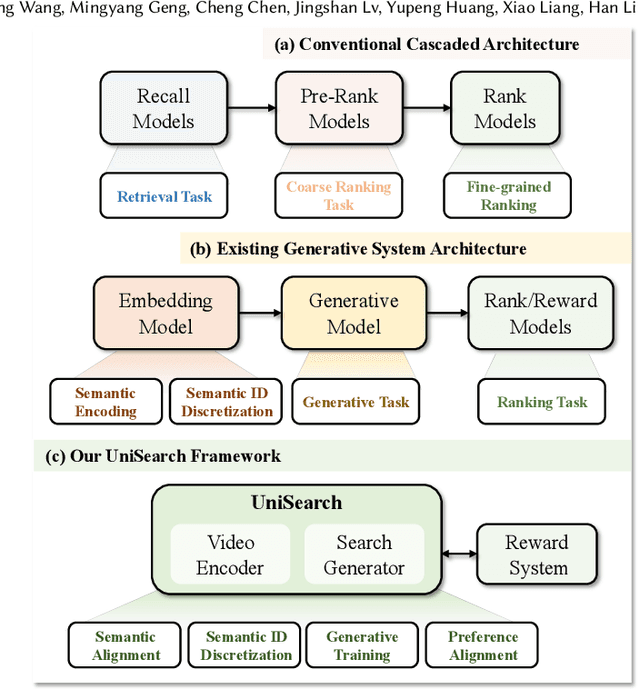
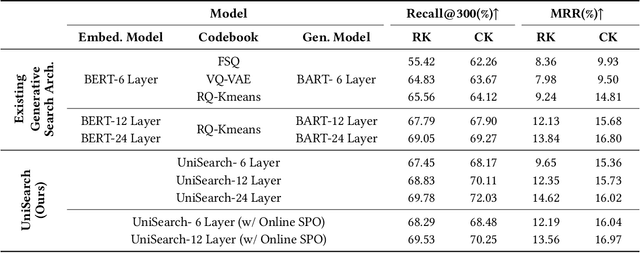
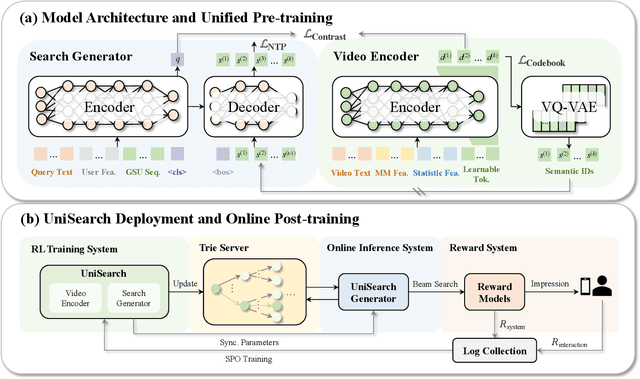
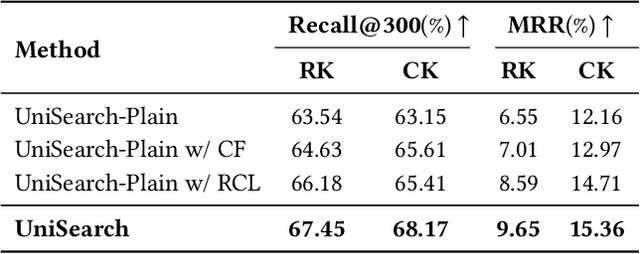
Modern search systems play a crucial role in facilitating information acquisition. Traditional search engines typically rely on a cascaded architecture, where results are retrieved through recall, pre-ranking, and ranking stages. The complexity of designing and maintaining multiple modules makes it difficult to achieve holistic performance gains. Recent advances in generative recommendation have motivated the exploration of unified generative search as an alternative. However, existing approaches are not genuinely end-to-end: they typically train an item encoder to tokenize candidates first and then optimize a generator separately, leading to objective inconsistency and limited generalization. To address these limitations, we propose UniSearch, a unified generative search framework for Kuaishou Search. UniSearch replaces the cascaded pipeline with an end-to-end architecture that integrates a Search Generator and a Video Encoder. The Generator produces semantic identifiers of relevant items given a user query, while the Video Encoder learns latent item embeddings and provides their tokenized representations. A unified training framework jointly optimizes both components, enabling mutual enhancement and improving representation quality and generation accuracy. Furthermore, we introduce Search Preference Optimization (SPO), which leverages a reward model and real user feedback to better align generation with user preferences. Extensive experiments on industrial-scale datasets, together with online A/B testing in both short-video and live search scenarios, demonstrate the strong effectiveness and deployment potential of UniSearch. Notably, its deployment in live search yields the largest single-experiment improvement in recent years of our product's history, highlighting its practical value for real-world applications.
Benchmarking AI scientists in omics data-driven biological research
May 13, 2025The rise of large language models and multi-agent systems has sparked growing interest in AI scientists capable of autonomous biological research. However, existing benchmarks either focus on reasoning without data or on data analysis with predefined statistical answers, lacking realistic, data-driven evaluation settings. Here, we introduce the Biological AI Scientist Benchmark (BaisBench), a benchmark designed to assess AI scientists' ability to generate biological discoveries through data analysis and reasoning with external knowledge. BaisBench comprises two tasks: cell type annotation on 31 expert-labeled single-cell datasets, and scientific discovery through answering 198 multiple-choice questions derived from the biological insights of 41 recent single-cell studies. Systematic experiments on state-of-the-art AI scientists and LLM agents showed that while promising, current models still substantially underperform human experts on both tasks. We hope BaisBench will fill this gap and serve as a foundation for advancing and evaluating AI models for scientific discovery. The benchmark can be found at: https://github.com/EperLuo/BaisBench.
The Computational Anatomy of Humility: Modeling Intellectual Humility in Online Public Discourse
Oct 19, 2024
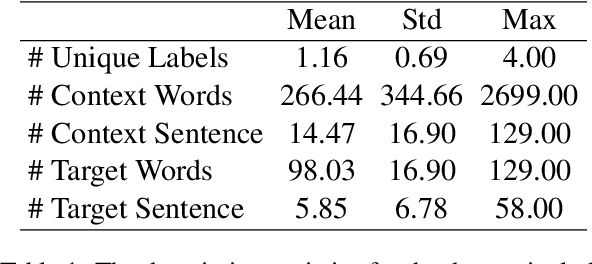
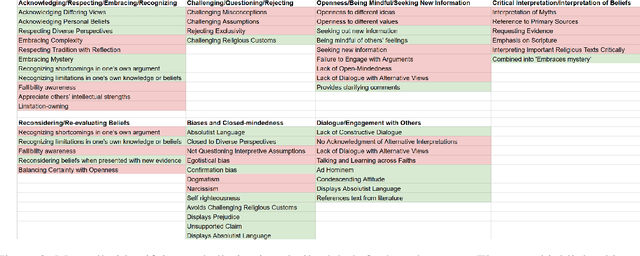
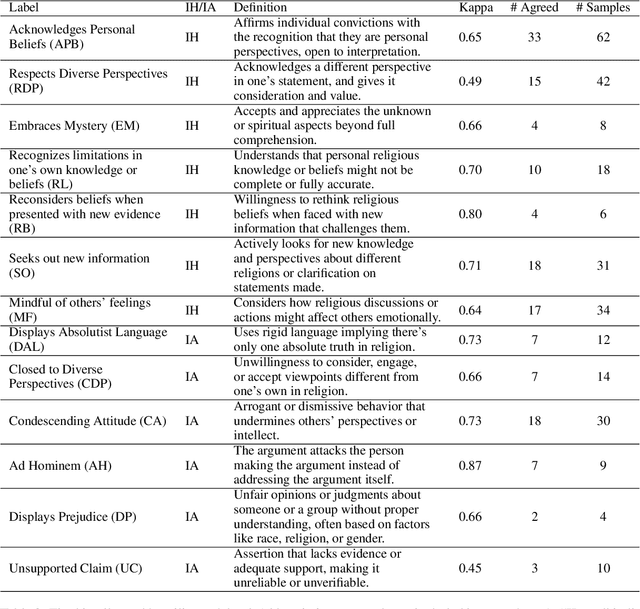
The ability for individuals to constructively engage with one another across lines of difference is a critical feature of a healthy pluralistic society. This is also true in online discussion spaces like social media platforms. To date, much social media research has focused on preventing ills -- like political polarization and the spread of misinformation. While this is important, enhancing the quality of online public discourse requires not just reducing ills but also promoting foundational human virtues. In this study, we focus on one particular virtue: ``intellectual humility'' (IH), or acknowledging the potential limitations in one's own beliefs. Specifically, we explore the development of computational methods for measuring IH at scale. We manually curate and validate an IH codebook on 350 posts about religion drawn from subreddits and use them to develop LLM-based models for automating this measurement. Our best model achieves a Macro-F1 score of 0.64 across labels (and 0.70 when predicting IH/IA/Neutral at the coarse level), higher than an expected naive baseline of 0.51 (0.32 for IH/IA/Neutral) but lower than a human annotator-informed upper bound of 0.85 (0.83 for IH/IA/Neutral). Our results both highlight the challenging nature of detecting IH online -- opening the door to new directions in NLP research -- and also lay a foundation for computational social science researchers interested in analyzing and fostering more IH in online public discourse.
Enhanced Detection of Conversational Mental Manipulation Through Advanced Prompting Techniques
Aug 14, 2024

This study presents a comprehensive, long-term project to explore the effectiveness of various prompting techniques in detecting dialogical mental manipulation. We implement Chain-of-Thought prompting with Zero-Shot and Few-Shot settings on a binary mental manipulation detection task, building upon existing work conducted with Zero-Shot and Few- Shot prompting. Our primary objective is to decipher why certain prompting techniques display superior performance, so as to craft a novel framework tailored for detection of mental manipulation. Preliminary findings suggest that advanced prompting techniques may not be suitable for more complex models, if they are not trained through example-based learning.
Serial Position Effects of Large Language Models
Jun 23, 2024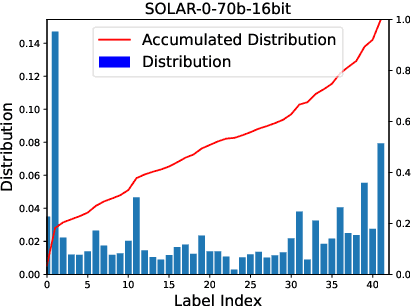
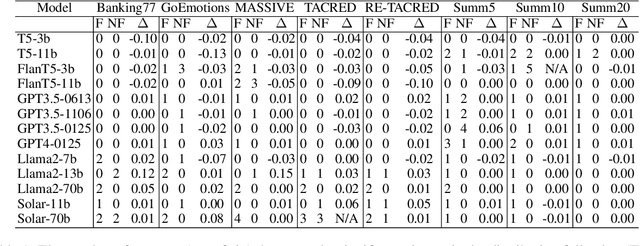
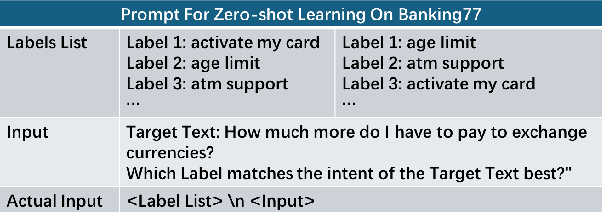
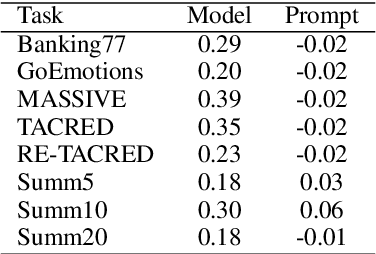
Large Language Models (LLMs) have shown remarkable capabilities in zero-shot learning applications, generating responses to queries using only pre-training information without the need for additional fine-tuning. This represents a significant departure from traditional machine learning approaches. Previous research has indicated that LLMs may exhibit serial position effects, such as primacy and recency biases, which are well-documented cognitive biases in human psychology. Our extensive testing across various tasks and models confirms the widespread occurrence of these effects, although their intensity varies. We also discovered that while carefully designed prompts can somewhat mitigate these biases, their effectiveness is inconsistent. These findings underscore the significance of serial position effects during the inference process, particularly in scenarios where there are no ground truth labels, highlighting the need for greater focus on addressing these effects in LLM applications.
MODABS: Multi-Objective Learning for Dynamic Aspect-Based Summarization
Jun 05, 2024
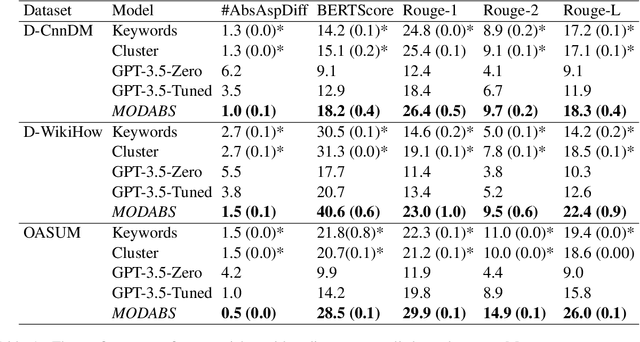
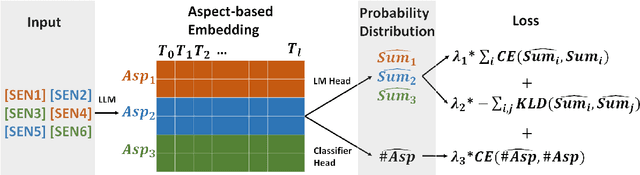
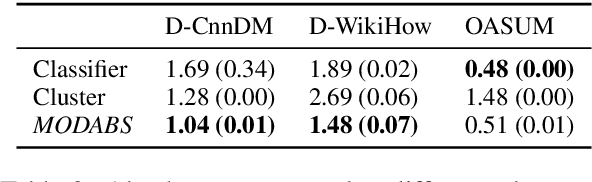
The rapid proliferation of online content necessitates effective summarization methods, among which dynamic aspect-based summarization stands out. Unlike its traditional counterpart, which assumes a fixed set of known aspects, this approach adapts to the varied aspects of the input text. We introduce a novel multi-objective learning framework employing a Longformer-Encoder-Decoder for this task. The framework optimizes aspect number prediction, minimizes disparity between generated and reference summaries for each aspect, and maximizes dissimilarity across aspect-specific summaries. Extensive experiments show our method significantly outperforms baselines on three diverse datasets, largely due to the effective alignment of generated and reference aspect counts without sacrificing single-aspect summarization quality.